
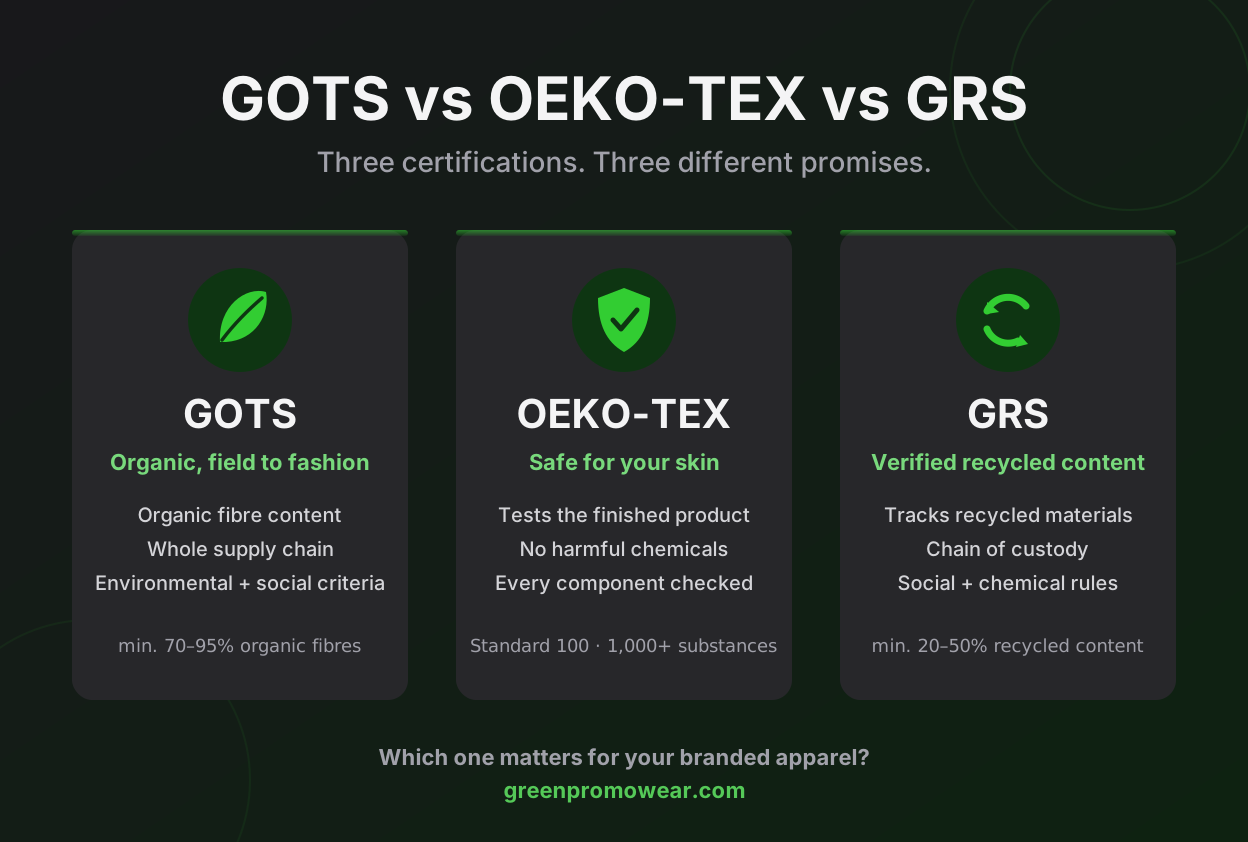
Every product we sell carries at least one independent textile certification — and if you've browsed our store, you've seen the badges: GOTS, OEKO-TEX, GRS. It's the question we get most often from buyers: which one actually matters?
The short answer: they're not competing standards. They certify completely different things, and the best products combine two or more of them.
- GOTS certifies organic fibre content — plus environmental and social criteria across the entire supply chain.
- OEKO-TEX Standard 100 certifies chemical safety — the finished product is tested for harmful substances.
- GRS certifies recycled content — verified through the chain of custody, with social and chemical requirements on top.
The comparison at a glance
| GOTS | OEKO-TEX Standard 100 | GRS | |
|---|---|---|---|
| What it certifies | Organic fibres, processed responsibly | The finished product is free from harmful levels of ~1,000 substances | Recycled material content, tracked through the supply chain |
| Scope | Entire supply chain, field to garment | The end product (every component: fabric, thread, print, zipper) | Entire chain of custody, recycling plant to garment |
| Minimum threshold | 70% organic fibres ("made with organic"), 95% for the "organic" label | Pass/fail against limit values per product class | 20% recycled content to certify, 50% to carry the logo |
| Social criteria | Yes — ILO-aligned labour requirements | No | Yes — ILO-aligned labour requirements |
| What it does not tell you | Nothing about recycled content | Nothing about organic or recycled origin, or working conditions | Nothing about whether virgin fibres are organic |
| Require it when | You want organic natural fibres (cotton, wool, hemp) with verified ethics | Always — it's the baseline for anything worn against skin | You want synthetic fibres (polyester, nylon) with a real circularity claim |
GOTS — organic, from field to fashion
The Global Organic Textile Standard is the strictest of the three in scope. It requires certified organic fibres (no synthetic pesticides, no GMOs) and audits every processing step — dyeing, printing, sewing — against environmental and social criteria. Independent bodies inspect the whole chain annually.
GOTS is the certification to require for natural fibres: organic cotton tees, sweatshirts, and tote bags. What it can't tell you: whether a product contains recycled materials — that's GRS territory.
Deep dive: our introduction to GOTS certification.
OEKO-TEX Standard 100 — safe against the skin
OEKO-TEX Standard 100 answers a different question entirely: is the finished garment safe to wear? Every component — fabric, sewing thread, buttons, prints — is lab-tested against limit values for around 1,000 harmful substances, often stricter than legal requirements.
It says nothing about where the fibres came from or how workers were treated. But as a baseline for anything your team wears against their skin, it's the one certification we'd call non-negotiable. That's why you'll find it on many garments in our range, always alongside GOTS or GRS.
Deep dive: what OEKO-TEX Standard 100 means.
GRS — recycled content you can verify
The Global Recycled Standard exists because "made from recycled materials" is one of the easiest claims to greenwash. GRS verifies the recycled percentage through every step of the chain of custody, and adds social criteria and chemical restrictions on top.
GRS is what to require for synthetic fibres — recycled polyester and nylon in t-shirts, caps, and bags. A product needs at least 20% recycled content to be certified, and 50% to carry the GRS logo.
Deep dive: what the Global Recycled Standard covers.
What about OCS 100 and PETA-Approved Vegan?
Two more labels you'll see in our range. OCS 100 verifies organic fibre content like GOTS, but without GOTS's processing and social requirements — think of it as "GOTS light", common on totes and accessories. PETA-Approved Vegan confirms no animal-derived materials anywhere in the product — relevant if your company has a vegan or animal-welfare policy.
So which should you require?
It depends on what you're ordering and why:
- Team swag people will wear (tees, hoodies): OEKO-TEX as the baseline, plus GOTS for cotton or GRS for recycled polyester.
- Sustainability reporting: GOTS and GRS both provide chain-of-custody verification you can actually cite — vague "eco-friendly" claims don't survive an audit.
- Vegan or animal-welfare policy: add PETA-Approved Vegan to the list.
Every textile product in our store, with its certifications
Every textile product we sell is third-party certified. Here is the current range, taken directly from the certification section of each product page — the strongest pieces combine three or more standards:
- Unisex Staple Eco T-Shirt (Bella + Canvas) — GRS
- Unisex Organic Mid-Light T-Shirt (Stanley/Stella) — GOTS, OCS
- Women's Organic Ribbed Neck T-Shirt (Stanley/Stella) — GOTS, OCS
- Unisex Organic Sweatshirt (SOL'S) — GOTS, OEKO-TEX, GRS, OCS, PETA-Approved Vegan
- Unisex Organic Raglan Sweatshirt (SOL'S) — GOTS, OEKO-TEX, GRS, OCS, PETA-Approved Vegan
- Women's Organic Crew Neck Sweatshirt (Stanley/Stella) — GOTS, GRS, OCS
- Unisex Organic Oversized Sweatshirt (Stanley/Stella) — GOTS, GRS, OCS
- Unisex Eco Raglan Hoodie (SOL'S) — GOTS, OEKO-TEX, GRS, OCS, PETA-Approved Vegan
- Unisex Organic Relaxed Hoodie (Stanley/Stella) — GOTS, GRS, OCS
- Eco Tote Bag (Econscious) — GOTS, OEKO-TEX, OCS, PETA-Approved Vegan
- Large Eco Tote (Econscious) — GOTS, OEKO-TEX, OCS, PETA-Approved Vegan
- Organic Baseball Cap (Econscious) — OCS, GRS
- Organic Cotton Apron (SOL'S) — OCS
Non-textile items — like the stainless steel water bottle, mug, notebook, and mouse pad — fall outside textile certification schemes, which is why you won't see these labels on them. The full overview of what each standard covers is on our certifications page.
Ordering for a distributed team? Our guide to swag for remote teams covers sizing, shipping, and how to avoid the landfill pile.