
Sending swag to a co-located team is relatively easy: collect a box with size samples from your local swag store, let everyone try them on, and pick their size. Then order a box with your items, drop them in the kitchen, done. Sending swag to a remote team is where it falls apart — 40 people in 15 countries, no shared office, no idea who's a small and who's an XL, and no one wants to collect home addresses in a spreadsheet.
This guide covers how to run remote team swag that people actually keep and wear — without the size guessing, the shipping headaches, or the pile of unworn t-shirts that ends up in landfill.
Why remote swag is harder than it looks
Three problems show up every single time:
Sizing. In an office you can eyeball it or try it out. Remotely, sizes are pure guesses — and wrong sizes are the number one reason branded clothing doesn't get used — at all. Much of promotional apparel ends up in landfill simply because it didn't fit. Read more about the sizing problem.
Chasing people with reminders. Some people will not provide their size, or their shipping address, unless you remind them multiple times. This is frustrating, and in the worst case you will miss your deadline.
Logistics. Shipping individually to 15 countries means lots of packages and shipping slip creations, tracking chaos, and emissions from gear flying across the world — first to you, and then to everyone else from one central location. See our shipping overview for how direct-to-door fulfilment works.
Solve these three and remote swag stops being a chore.
What makes swag worth keeping (not landfill)
Not all branded gear is equal. The stuff people actually wear has a few things in common:
- It fits. Obvious, but it's the whole game. Get sizing right and everything else follows.
- The quality is good. A scratchy 180gsm tee gets worn once. A proper organic-cotton piece becomes a favorite.
- The branding is subtle and well-made. A clean embroidered logo beats a giant chest print every time.
- It aligns with values. Increasingly, teams care that their gear is certified (GOTS organic cotton, GRS recycled polyester, OEKO-TEX tested) rather than vaguely “eco.”
If you're spending the money anyway, spending it on something that gets worn for years is both better branding and far less waste.
The 5-step playbook for remote team swag
Here's a process that removes the manual work:
- Pick certified, good-quality base products. Start with versatile staples — a recycled tee, an organic sweatshirt, a tote, a reusable bottle. Look for third-party certifications, not just “sustainable” claims.
- Let recipients self-enroll. Instead of collecting addresses yourself, send each person a private link where they enter their own shipping details. Cleaner, faster, and better for privacy.
- Solve sizing without samples. Ask each recipient a few quick questions (height, weight, fit preference) and match that to the specific garment, so everyone gets a recommended size privately — before anything is produced.
- Ship direct to each door. Fulfil from the warehouse nearest each person, not one central hub. Faster delivery, lower emissions, individual tracking.
- Approve once and you're done. Review the total, confirm, and let your supplier handle production, reminders, and worldwide delivery.
Done this way, an order for a globally distributed team takes minutes instead of hours or days. See how the platform works or watch our step-by-step guides and videos.
When to send remote swag
A few moments where it lands especially well:
- New-hire welcome kits — the first day matters more when there's no office to walk into. See our onboarding gifts guide.
- Company milestones and launches — a shared piece of gear is one of the few tangible things a remote team can hold at the same time.
- Offsites and retreats — matching pieces for the one time a year everyone's together.
- Client and community gifting — same logistics problem, same solution.
You don't need a minimum order to do this well — a single welcome kit for one new hire should be as easy as 500 hoodies for a launch.
The sustainability angle you can't ignore
Fashion accounts for up to 20% of global clean-water pollution, and promotional clothing is a notorious contributor — largely because so much of it is the wrong size and gets binned. For remote teams the waste risk is even higher, since sizes are guessed.
Two things cut that waste dramatically: getting the size right the first time, and choosing only certified low-impact materials. Do both and your swag program goes from a guilty footnote to something you can actually put in your sustainability report.
Make it effortless
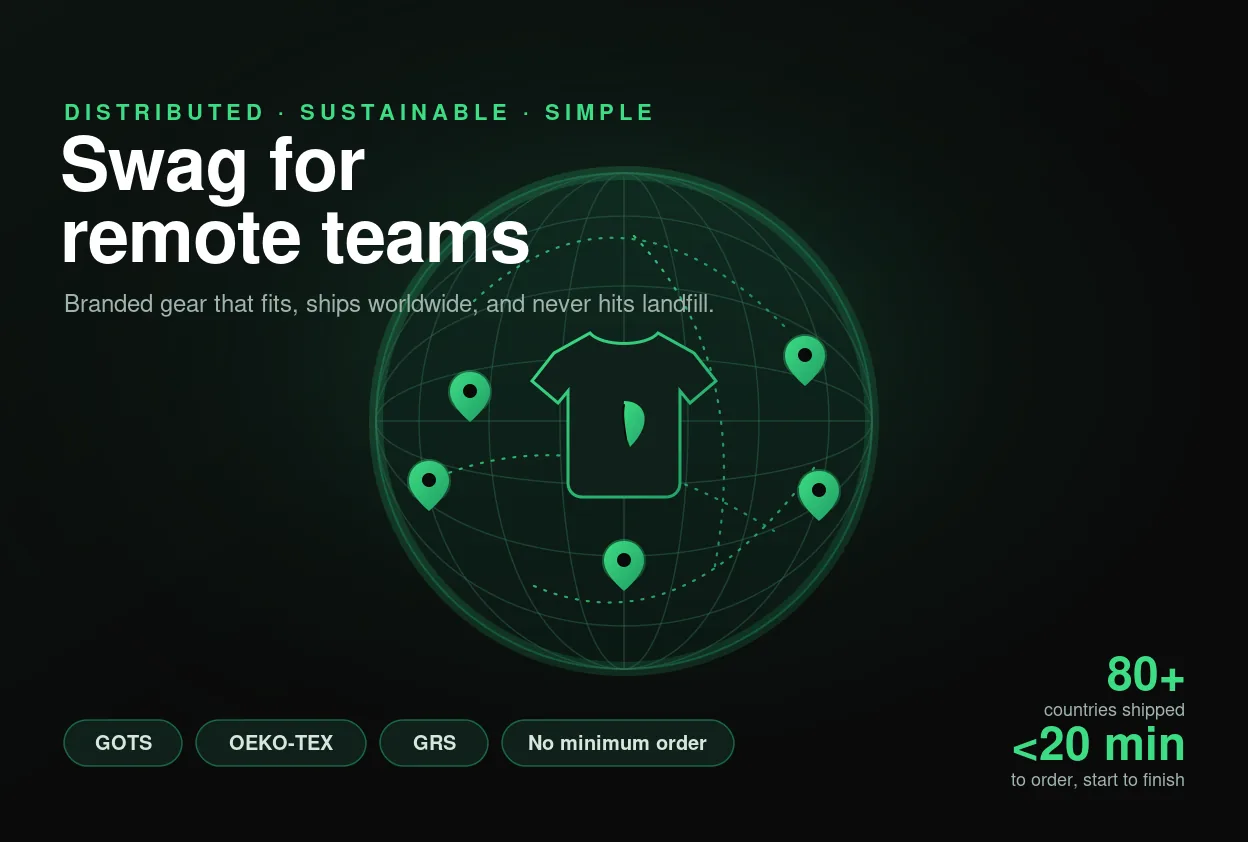
Most of the pain in remote swag — sizing, addresses, customs, emissions — is solvable with the right process. At Green Promo Wear we built the whole flow around it: only GOTS / OEKO-TEX / GRS certified products, smart size recommendations sent privately to each recipient, recipients self-enter their own addresses, and direct-to-door shipping to 80+ countries from the nearest fulfilment center. No minimums, and a full order takes under 20 minutes.
Want to try it? Grab a sample with code SAMPLE30 for 30% off one garment, or book a 30-minute demo and we'll set up your first order with you.
Frequently asked questions
How do you handle sizing for a remote team?
Each recipient answers a short set of fit questions, and Green Promo Wear matches the answers to the right size for that specific garment. Everyone gets a recommended size privately before production starts — no samples or size spreadsheets needed.
How do you collect everyone's shipping address?
You don't. Each recipient gets a secure link to enter their own address, which keeps the process fast and protects their privacy.
Is there a minimum order?
There shouldn't be. A single welcome kit for one new hire should be as easy to order as gear for a 500-person launch.
What makes swag “sustainable”?
Third-party certification — like GOTS organic cotton, GRS recycled polyester, and OEKO-TEX tested fabrics — plus getting the size right so it doesn't end up in landfill.